Clean Biome Review 2026 - Is Clean Program's Probiotic Worth It? is presented for general information by MexicanPharm24. This is not medical advice and we do not sell or ship medications. Read the label and consult a licensed healthcare professional before use.
 Synbiotic-20%
Clean Biome Review: Is Clean Program's Daily Probiotic Worth It?
300 reviews
An honest Clean Biome review: the 9-strain, 45 billion CFU synbiotic with S. boulardii, the undisclosed proprietary blend, the hormone/weight claims, and how Clean Biome compares to Seed and Ritual.
Reviewed July 2, 2026
Is Clean Biome worth it? My honest Clean Biome review at a glance
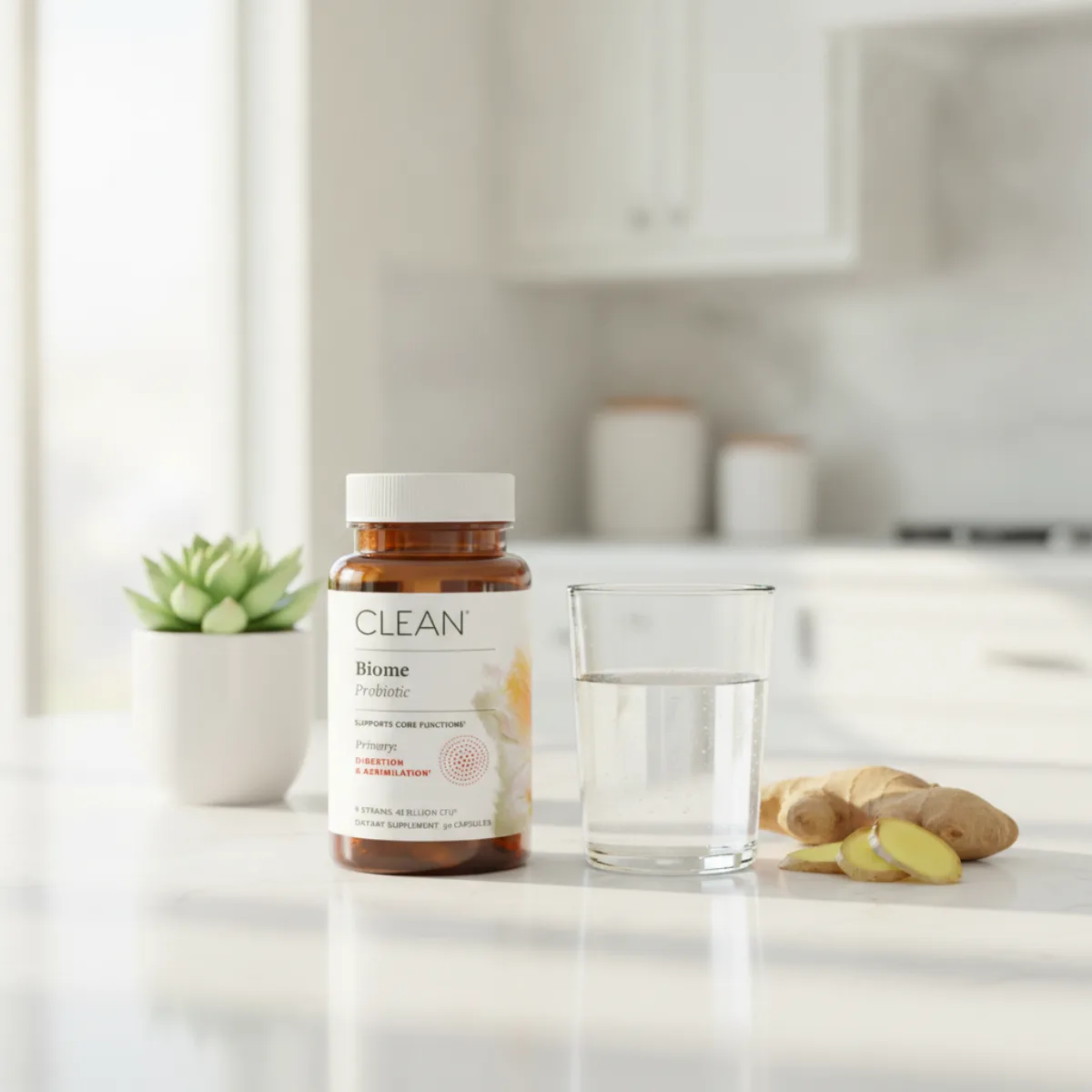
Clean Biome is the once-daily probiotic from Clean Program, the wellness brand founded by cardiologist Dr. Alejandro Junger. It's a genuine synbiotic — a 9-strain, 45 billion CFU blend that includes the acid-resistant yeast Saccharomyces boulardii, paired with two prebiotic fibers (FOS and FiberAid larch arabinogalactan) to feed the bacteria. That's a smart, on-trend design, and at $39 (or ~$31 on subscription) it undercuts premium rivals like Seed and Ritual. The catch: Clean Program hides 8 of its 9 strains behind a "proprietary blend," and its hormone and weight-management claims run ahead of the evidence. Let's break down what's real.
I went through the formula, the S. boulardii science, the realistic timeline, the price versus Seed and Ritual, and the transparency question. Here's my straight take.
Clean Biome is a well-designed daily synbiotic (9 strains, 45 billion CFU, S. boulardii, plus FOS + FiberAid prebiotics) from a credible founder, priced below Seed and Ritual. The upside: the acid-resistant S. boulardii yeast is a genuine, evidence-backed strength, the dual-prebiotic synbiotic design is legit, and one capsule a day is easy. The honest catches: only 1 of the 9 strains is actually disclosed (the rest is a proprietary blend with no per-strain CFU), there's no third-party certification, and the "hormone balance" and "weight management" claims aren't well supported. A solid, fairly priced probiotic — if you can live with the missing strain transparency.
The essentials of my Clean Biome review
My rating: 7/10 — a genuinely good synbiotic with a real S. boulardii edge and fair price, held back by an opaque proprietary blend and overreaching hormone/weight claims.
Key spec: one capsule a day — 9 strains, 45 billion CFU, S. boulardii + FOS/FiberAid prebiotics.
| Detail | Clean Biome |
|---|---|
| Brand | Clean Program (founded by Dr. Alejandro Junger, cardiologist & author of Clean) |
| Format | Capsule — 1/day, empty stomach in the morning; 30 capsules (1-month supply), shelf-stable |
| Potency | 45 billion CFU, 9-strain blend |
| Standout ingredient | Saccharomyces boulardii (acid-resistant probiotic yeast) + FOS & FiberAid prebiotics |
| Transparency | Low — only S. boulardii named; other 8 strains are a proprietary blend, no per-strain CFU, no third-party cert |
| Price | $39 one-time / ~$31.20 subscription (~$1.04–1.30/day); 30-day guarantee |
✅ What I liked about Clean Biome
- ✅ A real synbiotic design — probiotics plus two prebiotic fibers (FOS + FiberAid) to actually feed them, which many probiotics skip.
- ✅ Contains S. boulardii, an acid-resistant yeast with genuine clinical backing — a strength most multi-strain probiotics lack.
- ✅ Sensible 45 billion CFU (plenty without CFU-flexing) and easy one-capsule, shelf-stable dosing.
- ✅ Credible founder (a board-certified cardiologist) and a fair price that undercuts Seed and Ritual.
- ✅ Vegan capsule, dairy-free, no refrigeration needed.
❌ What held Clean Biome back
- ❌ Only 1 of 9 strains is disclosed — the rest is a "proprietary blend" with no per-strain CFU, and even the S. boulardii strain isn't specified.
- ❌ No third-party certification (unlike the transparency-first premium brands).
- ❌ The "hormone balance" and "weight management" claims aren't well supported by evidence.
- ❌ On-site reviews (4.9/5) are not independently verifiable, and the brand is thin on third-party reviews.
💡 There's a 30-day guarantee — and give any probiotic a few weeks before you judge it.
In this Clean Biome review:
- What is Clean Biome, and who makes it?
- What's actually inside Clean Biome?
- Does the S. boulardii in Clean Biome matter?
- Does Clean Biome actually work for bloating and regularity?
- Is 45 billion CFU and 9 strains better in Clean Biome?
- Can Clean Biome really balance hormones and help with weight?
- How much does Clean Biome cost, and is it good value?
- How does Clean Biome compare to Seed, Ritual and Florastor?
- How do you take Clean Biome, and are there side effects?
- What do real customers say about Clean Biome?
- My verdict on Clean Biome
- Clean Biome FAQ
What is Clean Biome, and who makes it?
Clean Biome is made by Clean Program, the wellness brand built around Dr. Alejandro Junger and his 2009 New York Times bestseller Clean. That founder story is a real credibility signal: Junger is a board-certified cardiologist (NYU training, a cardiology fellowship at Lenox Hill) who pivoted to functional and gut-focused medicine. Clean Program has sold cleanses and supplements to a large customer base for over a decade, so this isn't a fly-by-night operation.
⚠️ The honest nuance: a credible founder isn't the same as a clinically proven product. Junger's Clean program and philosophy have been criticized for not citing sources and for the cleanses not being clinically tested. So treat "created by a cardiologist" as a genuine trust marker for quality and intent — not as proof that Clean Biome itself has been through clinical trials (it hasn't; almost no consumer probiotic has). If you value Clean Program's ecosystem, Clean Biome pairs naturally with the brand's Digest Plus digestive enzyme and its Clean21 reset program.
What's actually inside Clean Biome?
On paper, the formula is thoughtfully built. Each daily capsule delivers:
- 🦠 45 billion CFU across a 9-strain blend — a mix of Lactobacillus and Bifidobacterium species plus the yeast Saccharomyces boulardii.
- 🌾 FOS (fructooligosaccharides) — a well-studied prebiotic fiber that selectively feeds Bifidobacterium and Lactobacillus.
- 🌿 FiberAid™ larch arabinogalactan — a second, slower-fermenting prebiotic with some early immune-support research.
- 💊 A vegan hypromellose capsule (rice flour, magnesium stearate, silicon dioxide as excipients), shelf-stable.
That probiotic-plus-prebiotic combination makes Clean Biome a true synbiotic, which is the right modern approach — feeding the bacteria you're adding, not just adding them.
⚠️ But here's the real weakness, and it's the crux of this review: Clean Program only names one of the nine strains (S. boulardii). The other eight are hidden inside a "proprietary blend," and there's no per-strain CFU disclosure and no third-party certification. In 2026, that matters — because a probiotic's benefits are strain-specific, you can't fully evaluate what you're buying without the strain names and doses. The transparency-first brands (Seed lists all 24 strains with reference codes; Ritual names its 2) have set a higher bar, and Clean Biome doesn't meet it. It's likely a fine formula — you just have to take most of it on trust.
Does the S. boulardii in Clean Biome matter?
Yes — this is Clean Biome's most genuinely valuable ingredient, and the one most multi-strain probiotics don't have. Saccharomyces boulardii is a probiotic yeast, not a bacterium, and that gives it two real advantages: it's naturally resistant to stomach acid (so more of it survives the trip to your gut), and it's not killed by antibiotics (so you can take it during a course).
The evidence here is legitimately strong: in a meta-analysis, S. boulardii cut the risk of antibiotic-associated diarrhea from about 18.7% to 8.5%. That's a real, measurable benefit few probiotics can point to.
⚠️ The honest caveat: that gold-standard evidence is for a specific patented strain, S. boulardii CNCM I-745 (the one in Florastor). Clean Program doesn't specify which S. boulardii strain it uses — so while including the yeast is a smart, credible move, you can't assume Clean Biome's version carries the exact same clinical track record. If antibiotic-associated diarrhea is your specific concern, a single-strain, strain-identified option like the Florastor S. boulardii probiotic is the more proven choice; Clean Biome's edge is combining that yeast with 8 bacterial strains and prebiotics for general daily use.
Does Clean Biome actually work for bloating and regularity?
For its core job — everyday digestion, regularity and reducing bloating — a well-built synbiotic like Clean Biome is a reasonable bet, provided you set realistic expectations on timing. Probiotics are not a fast-acting pill.
🗓️ What to realistically expect, week by week:
- Week 1 (days 1–14): you may feel more gassy or bloated at first. This is normal — it's your microbiome adjusting, not the product failing. It usually fades. Take it on an empty stomach in the morning.
- Weeks 2–3: this is when most people start noticing the wins — less bloating, more regular, more "running smoothly," as reviewers put it. The prebiotic fiber contributes here too.
- Weeks 4–12: deeper, more consistent gut benefits build over 8–12 weeks. Chronic issues take the longest; consistency is everything.
💡 The fair read: if you're expecting an overnight de-bloat, you'll be disappointed — that's true of every probiotic, not just Clean Biome. Give it a full month (the 30-day guarantee lines up with that), and don't quit in week one because of the adjustment gas. If nothing has changed after ~8 weeks of daily use, it's probably not the right strain mix for you.
Is 45 billion CFU and 9 strains better in Clean Biome?
This is worth addressing head-on, because supplement marketing trains you to think bigger numbers are better. With probiotics, that's mostly a myth — and a fair Clean Biome review should say so even though it slightly undercuts the sales pitch.
- 🔬 More CFU isn't automatically better. A meta-analysis in IBS found no significant difference between high-dose and low-dose probiotics; many clinical benefits show up at just 1–10 billion CFU. Clean Biome's 45 billion is plenty — but it's not a magic advantage over a 10–15 billion product.
- 🔬 More strains isn't automatically better either. Across 65 randomized trials, multi-strain blends were roughly equivalent to single, well-chosen strains. "9 strains" sounds impressive, but a targeted single strain can match it for a given goal.
➡️ So read Clean Biome's "45 billion CFU, 9 strains" as sensible and sufficient, not as proof of superiority. What actually matters is which strains and whether they suit your issue — which is exactly why the undisclosed blend is frustrating. The real, defensible edges here are the S. boulardii yeast and the dual prebiotics, not the headline numbers.
Can Clean Biome really balance hormones and help with weight?
Clean Program lists "aids in balancing hormones" and "supports healthy weight management" among Clean Biome's benefits. This is where I have to be straight with you, because it's a health-and-money (YMYL) claim: the evidence for probiotics doing either of these is weak and mixed.
- ⚖️ Weight: some studies show a modest effect in specific groups (e.g., overweight women), but the overall evidence is inconclusive. A probiotic is not a weight-loss product, and Clean Biome won't function like one.
- 🔄 Hormones: the gut microbiome does interact with hormone metabolism, but any effect from a general probiotic is indirect and poorly documented. "Balances hormones" overstates what the science can currently support.
➡️ My advice: buy Clean Biome for what it can plausibly do — support digestion, regularity and gut health, and provide S. boulardii — and treat the hormone and weight claims as marketing optimism, not reasons to buy. If a supplement's biggest promises are the least-proven ones, that's a flag worth noting, even on an otherwise solid product.
How much does Clean Biome cost, and is it good value?
Clean Biome runs $39 for a 30-day bottle, or about $31.20 on subscription — roughly $1.04 to $1.30 per day, with a 30-day guarantee.
💰 On value, this is actually one of Clean Biome's stronger points. It's cheaper than the premium synbiotics it competes with: Seed runs ~$50/month and Ritual ~$54/month, both subscription-locked. For a 9-strain synbiotic that includes S. boulardii and dual prebiotics, ~$31–39 is fair-to-good pricing.
➡️ The honest offset: you're paying a mid-market price but getting budget-tier transparency (no full strain list, no third-party cert). So the value verdict depends on what you weigh more — if it's price and a sensible synbiotic formula, Clean Biome is good value; if it's knowing exactly which strains and doses you're getting, Seed or Ritual justify their premium.
How does Clean Biome compare to Seed, Ritual and Florastor?
Here's how Clean Biome stacks up against the probiotics US buyers most often cross-shop.
| Product | Price | Potency / strains | Strength | Weakness |
|---|---|---|---|---|
| Clean Biome | $39 (~$31 sub) | 45B CFU, 9 strains + prebiotics | S. boulardii + dual prebiotic; good price; 1/day | 8 of 9 strains undisclosed; no 3rd-party cert |
| Seed DS-01 | ~$50/mo | 53.6B AFU, 24 strains (all named) | Full strain disclosure; multiple RCTs; heavy testing | No S. boulardii; premium; 2 caps/day; sub-locked |
| Ritual Synbiotic+ | ~$54/mo | 11B CFU, 2 strains + postbiotic | 3-in-1 pre/pro/post; fully disclosed; certified | Only 2 strains; low CFU; priciest per serving |
| Florastor | ~$25–35 | S. boulardii CNCM I-745 (1 strain) | The proven S. boulardii strain; great after antibiotics | Single strain; no prebiotic; narrow use case |
So which should you choose? For full strain transparency and the deepest research, Seed. For a fully disclosed 3-in-1 (pre/pro/postbiotic), Ritual. For the proven S. boulardii strain after antibiotics, Florastor. Clean Biome's sweet spot is being the most complete "all-rounder" for the money — S. boulardii plus multi-strain bacteria plus dual prebiotics, cheaper than Seed/Ritual — as long as the undisclosed blend doesn't bother you. Prefer a fully clinician-style protocol? The Dr. Ruscio Triple Therapy Probiotic is a more therapeutic take that also uses S. boulardii.
How do you take Clean Biome, and are there side effects?
Dosing is simple: one capsule first thing in the morning with water, on an empty stomach (though the brand says it can be taken any time). It's shelf-stable, so no refrigeration.
⚠️ Side effects and safety:
- First-week gas or bloating is the most common effect and is a normal adjustment — start and stick with it; it usually settles within two weeks.
- The prebiotic fiber (FOS) can be a trigger for some very FODMAP-sensitive or IBS guts — ease in slowly if that's you.
- People who are immunocompromised, critically ill, or have a central venous catheter should be cautious with any probiotic (including S. boulardii yeast) and check with a doctor first.
- If you're pregnant, breastfeeding, or on medication, confirm with your clinician.
Probiotics aren't FDA-approved to treat any condition, and Clean Biome is a supplement, not a medicine. If you want help decoding any supplement label and its blend, see how to read a supplement and medication label.
What do real customers say about Clean Biome?
On Clean Program's own site, Clean Biome carries a 4.9/5 rating across about 300 reviews, with recurring praise for reduced bloating, better regularity and feeling "cleaner" and more regular. Those themes are consistent with what a decent synbiotic should deliver.
⚠️ The honest context: those are on-site reviews, which aren't independently verifiable, and Clean Biome has a thin third-party footprint — there's no dedicated Trustpilot page and only a recent Amazon listing, so there isn't yet a large body of outside reviews to cross-check. That's not a red flag by itself (it's a relatively new SKU), but it does mean you're leaning on the brand's own numbers. Weigh the genuinely good formula against the fact that the social proof is mostly first-party for now.
My verdict on Clean Biome — should you buy it?
Is Clean Biome worth it? My verdict is: yes for most people who want a solid all-rounder — 7/10.
To my mind, Clean Biome gets the important things right: it's a true synbiotic (probiotics + two prebiotics), it includes the genuinely useful acid-resistant S. boulardii yeast that most multi-strain products skip, it's easy to take, and it's priced below the premium competition. From a founder with real medical credentials, it's a credible, sensible daily probiotic.
What keeps it from a higher score is transparency and overreach: 8 of its 9 strains are hidden in a proprietary blend with no per-strain CFU or third-party certification, even the S. boulardii strain isn't specified, and the hormone/weight claims outrun the evidence. None of that means it's a bad product — it means you're trusting the brand on the details.
- 👍 Buy Clean Biome if you want one affordable daily capsule that combines S. boulardii, multiple bacterial strains and prebiotics, and you care more about a sensible synbiotic than about seeing every strain name.
- 👎 Skip it if you demand full strain disclosure and third-party testing (choose Seed or Ritual), you specifically need the proven S. boulardii strain after antibiotics (choose Florastor), or you're buying mainly for the hormone/weight claims (skip — the evidence isn't there).
➡️ Bottom line: Clean Biome is a well-formulated, fairly priced daily synbiotic with a real S. boulardii advantage — a good pick for everyday gut support, as long as you accept the proprietary-blend opacity and ignore the oversold hormone and weight promises. Judge it after a full month, not a gassy first week.
Give it the full 30-day guarantee window before deciding.
Clean Biome FAQ
What is Clean Biome?
Clean Biome is Clean Program's once-daily probiotic capsule — a synbiotic combining 9 strains (45 billion CFU), including the yeast Saccharomyces boulardii, with two prebiotic fibers (FOS and FiberAid larch arabinogalactan) to support digestion, regularity and gut health.
How long does Clean Biome take to work?
Most people notice less bloating and better regularity around weeks 2–3, with fuller gut benefits building over 8–12 weeks. Mild gas or bloating in the first 3–14 days is a normal adjustment, not a sign it isn't working. Give it the full 30-day guarantee window.
Does Clean Biome disclose all its strains?
No. Only one of the nine strains (Saccharomyces boulardii) is named; the other eight are a "proprietary blend" with no per-strain CFU listed, and there's no third-party certification. If full strain transparency matters to you, Seed and Ritual disclose all of theirs.
Is 45 billion CFU enough?
Yes — it's more than enough. Research shows many probiotic benefits occur at just 1–10 billion CFU, and higher counts aren't automatically better. What matters more is which strains you're getting and whether they suit your goal, so treat 45 billion as sufficient rather than a superiority claim.
Does Clean Biome help with weight or hormones?
The evidence is weak and mixed. Probiotics show at best a modest weight effect in some groups and only indirect, poorly documented hormone effects. Buy Clean Biome for digestion and gut support, not as a weight-loss or hormone-balancing product.
Is Clean Biome better than Seed or Florastor?
It depends. Seed wins on strain transparency and research; Florastor wins if you specifically want the proven S. boulardii CNCM I-745 strain after antibiotics. Clean Biome's advantage is being an affordable all-rounder that combines S. boulardii, multiple bacterial strains and prebiotics in one cheaper daily capsule.
How do you take Clean Biome?
Take one capsule first thing in the morning with water on an empty stomach (though it can be taken any time of day). It's shelf-stable and needs no refrigeration. Take it consistently every day for best results.
Keep reading before you buy Clean Biome
A little homework helps before committing to a daily probiotic:
- Florastor S. boulardii review — if the acid-resistant yeast is what interests you, this is the strain-identified specialist.
- Dr. Ruscio Triple Therapy Probiotic review — a more clinician-style protocol that also uses S. boulardii.
- Synbiotic 365 review — another probiotic-plus-prebiotic synbiotic to compare on price and strains.
- Clean Program Digest Plus review — the brand's digestive enzyme, a natural pairing with Clean Biome.
Disclaimer: This Clean Biome review is independent editorial information, not medical advice. Dietary supplements are not intended to diagnose, treat, cure or prevent any disease, and probiotic benefits are strain- and individual-specific; results vary. Evidence for probiotics affecting weight or hormones is limited and mixed. If you are pregnant, breastfeeding, immunocompromised, seriously ill, or taking medication, talk to a licensed healthcare professional before starting any probiotic. This page may contain affiliate links; we may earn a commission at no extra cost to you, which never changes our honest assessment. Pricing and formulations were accurate at the time of writing (July 2026) and may change — verify on the official site.