Life Extension Digestive Enzymes Review 2026 - Worth It? is presented for general information by MexicanPharm24. This is not medical advice and we do not sell or ship medications. Read the label and consult a licensed healthcare professional before use.
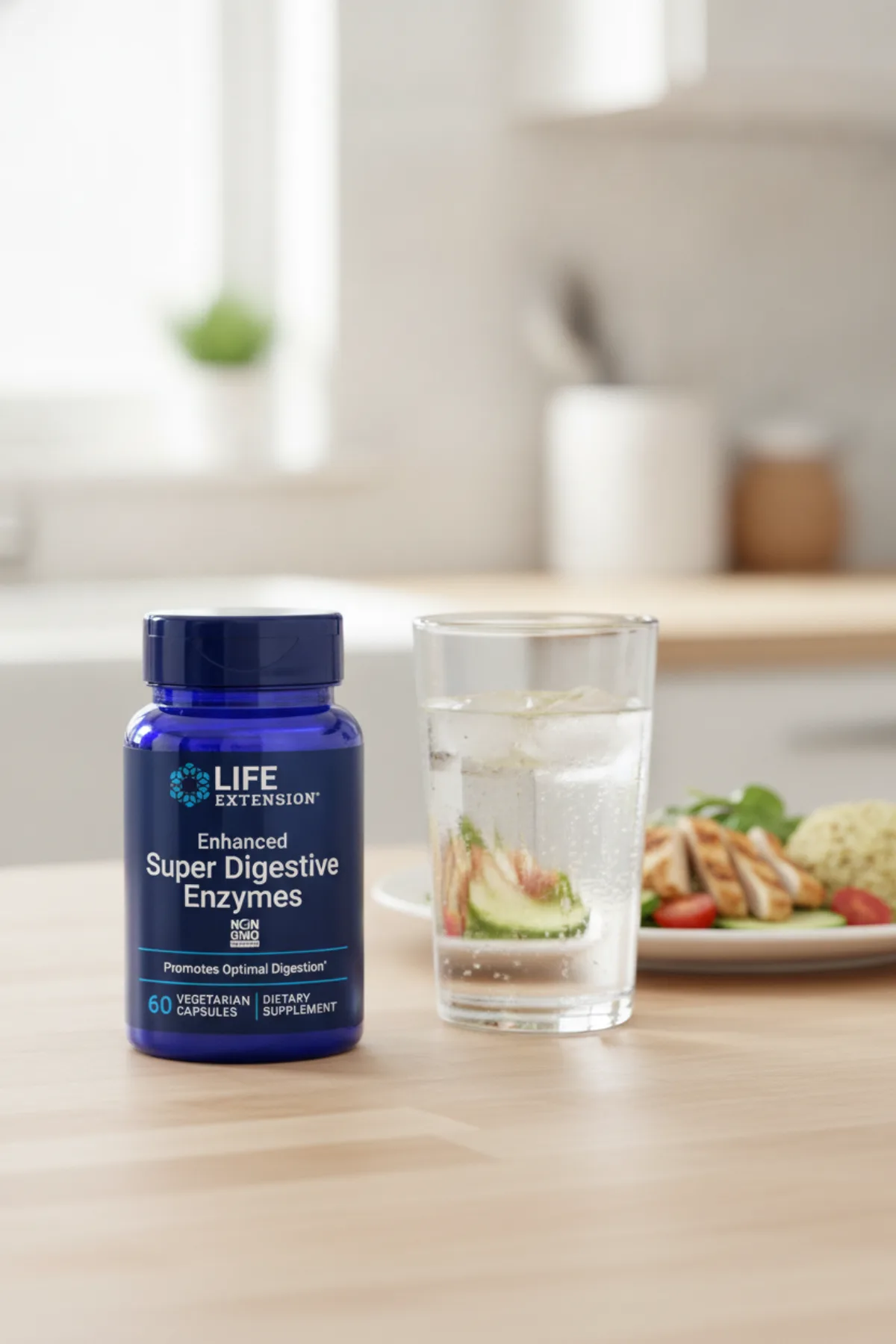 Best Value
Life Extension Digestive Enzymes Review: Best Value Enzyme?
620 reviews
An honest Life Extension Enhanced Super Digestive Enzymes review: the activity-unit formula, the wheat/soy allergen flag, the value price, and how it compares to Enzymedica.
Reviewed July 1, 2026
Is Life Extension Digestive Enzymes worth it? My honest review at a glance
Life Extension Digestive Enzymes (officially "Enhanced Super Digestive Enzymes") is one of the better-value broad-spectrum enzymes on the US market — a single veggie capsule covering protein, carbs, fat, fiber and dairy, from a brand that's been around since 1980. What sets it apart is transparency: it actually lists enzyme activity units, not just milligrams. But there's an allergen catch that trips up a lot of buyers. Let's dig in.
I went through the formula, the activity units, the allergen issue, the price, and the real feedback. Here's my honest take.
Life Extension Digestive Enzymes is a transparent, activity-unit-labeled, plant-based enzyme (protease, bromelain, amylase, lactase, cellulase, lipase) for meal-related bloating — and it's excellent value (~$0.37/serving retail, cheaper for members). The honest catches: it contains wheat and soy (from the fermentation substrate, so not for celiac/allergy), it omits alpha-galactosidase (beans), the "10 enzymes" claim is marketing (6 are listed), and OTC-enzyme evidence is modest. A smart everyday value pick with one real allergen caveat.
The essentials of my Life Extension Digestive Enzymes review
My rating: 7.6/10 — a transparent, well-priced, plant-based enzyme let down only by its wheat/soy content.
Key spec: 6 enzymes with full activity units, 1 capsule with meals.
| Detail | Life Extension Digestive Enzymes |
|---|---|
| Brand | Life Extension (Fort Lauderdale, FL; since 1980) |
| Format | Vegetarian capsules, 1 with meals, 60 caps (60 servings) |
| Type | Broad-spectrum plant/microbial enzyme (activity units listed) |
| Key actives | Protease 25,000 HUT, bromelain 800,000 PU, amylase 10,000 DU, lactase, cellulase, lipase |
| Price | ~$22 retail / ~$16.50 member / ~$15 AutoShip |
| Allergens | Contains wheat and soy; not gluten-free |
✅ What I liked
- ✅ Discloses activity units for every enzyme — the metric that actually indicates potency (a rare transparency win).
- ✅ Broad coverage (protein, carbs, fat, fiber, lactose) in one plant-based veggie cap.
- ✅ Excellent value (~$0.37/serving retail, cheaper for members) with a money-back guarantee.
- ✅ From a credible, transparency-focused brand operating since 1980.
❌ What held it back
- ❌ Contains wheat and soy (fermentation substrate) — unsuitable for celiac or wheat/soy allergy.
- ❌ Omits alpha-galactosidase (for beans) and glucoamylase that some rivals include.
- ❌ The marketed "10 enzymes" is really 6 on the panel; not the most potent for very large meals.
🎁 Member and AutoShip pricing drops it well below $22.
In this Life Extension Digestive Enzymes review:
- What's inside
- Why the activity units matter
- Do they contain allergens?
- Do they actually work?
- Who makes them
- Are they good value?
- How they compare
- Side effects and safety
- What customers say
- My verdict
- FAQ
What's inside Life Extension Digestive Enzymes?
Each vegetarian capsule delivers a 208mg plant/microbial-fermented enzyme blend — and, unusually, the label lists the activity units for each:
- 🥩 Protease SP — 25,000 HUT and bromelain — 800,000 PU for protein.
- 🍞 Amylase — 10,000 DU for starches/carbs.
- 🥛 Lactase — 2,000 ALU for dairy/lactose.
- 🌾 Cellulase — 2,000 CU for plant fiber, and lipase — 7,500 FIP for fat.
💡 That's genuinely broad coverage (protein, carbs, fat, fiber and dairy) in a single capsule. ⚠️ Two honesty notes: some listings market "10 enzymes," but the panel lists 6; and it does not include alpha-galactosidase (for beans/gas) or glucoamylase, which some competitors do.
Why do the activity units on Life Extension Digestive Enzymes matter?
This is a genuine strength worth explaining. With enzymes, milligrams tell you almost nothing about potency — activity units do (HUT for protease, DU for amylase, FIP for lipase, and so on). Many enzyme products, including premium ones, only list a total blend weight, so you can't judge how strong they actually are.
💡 Life Extension lists the activity units for every enzyme in this formula, which lets you verify the potency and compare it fairly to other products. That transparency is a real mark in its favor — ahead of even some pricier rivals (like Enzymedica's Digest Gold, which uses a proprietary Thera-blend without per-enzyme units).
Do Life Extension Digestive Enzymes contain allergens?
Yes — and this catches people out, so I'll be direct. Despite being plant-based, the label states it contains wheat and soy. That's because the Aspergillus-fermented enzymes are grown on wheat and soy substrates.
🚨 So Life Extension Digestive Enzymes is not gluten-free or soy-free, and is unsuitable for anyone with celiac disease, a wheat allergy, or a soy allergy. This is the single biggest reason a "plant-based enzyme" shopper might need to look elsewhere — a hypoallergenic option like Pure Encapsulations (gluten/soy/dairy-free) would be the safer pick for allergy-sensitive users.
Do Life Extension Digestive Enzymes actually work?
For its job — easing meal-related bloating and helping break down heavy or plant-heavy meals — users generally report it helps, and the broad coverage is well-matched to that.
How to use Life Extension Digestive Enzymes
- Take 1 capsule with meals (at the start of the meal), especially larger or higher-fiber ones.
- It works per meal, so there's no build-up period.
➡️ The honest read: reviewers report less bloating, gas and post-meal heaviness, particularly with big or plant-based meals. But be realistic — the evidence for OTC enzymes in otherwise-healthy people is supportive but modest (strongest for lactase with lactose, and alpha-galactosidase for beans, which this doesn't contain). It's a solid everyday helper, not a dramatic fix, and a minority of users feel little.
Who makes Life Extension Digestive Enzymes?
Life Extension is a Fort Lauderdale, Florida supplement company that's operated since 1980 — one of the oldest US direct-to-consumer supplement brands. It publishes Life Extension Magazine, runs a membership program, and is generally well-regarded for label transparency and quality control, emphasizing in-house and third-party testing and Certificates of Analysis (it's been included in independent testing like ConsumerLab).
➡️ So this is a credible, established brand, and the activity-unit labeling on this product reflects its above-average transparency. The main honest knocks are the wheat/soy substrate and the "10 enzymes" marketing overstatement.
Are Life Extension Digestive Enzymes good value?
Yes — value is arguably its biggest selling point. At about $22 retail for 60 capsules (~$0.37/serving), it's already reasonable, and Life Extension's member pricing (~$16.50) and AutoShip (~$15) push it lower, with frequent promos. That's cheap for a transparent, broad-spectrum enzyme.
💰 My take on the value: compared with premium enzymes at $40–$50 (Enzymedica, Pure Encapsulations), Life Extension delivers broad coverage and disclosed activity units for a fraction of the cost. Unless you specifically need the extra enzymes (alpha-galactosidase) or a hypoallergenic formula, it's one of the best value-per-transparency picks in the category. The money-back guarantee lowers the risk further.
How do Life Extension Digestive Enzymes compare to NOW, Enzymedica and Pure Encapsulations?
Here's how it stacks up against three digestive-enzyme products US shoppers cross-shop.
| Product | Price | Actives | Strength | Weakness |
|---|---|---|---|---|
| Life Extension Digestive Enzymes | ~$22 / 60 (cheaper for members) | 6 enzymes, activity units listed | Transparent units, plant-based, best value | Contains wheat & soy; no alpha-galactosidase |
| NOW Super Enzymes | ~$16–18 / 90 | Pancreatin, ox bile, betaine HCl, bromelain | Cheap; adds bile + betaine HCl for fat/acid | Animal-derived (not vegetarian); HCl not for all |
| Enzymedica Digest Gold | ~$45–50 / 90 | 23-enzyme vegan Thera-blend (+ alpha-gal, glucoamylase) | Broadest, high-potency, vegan | Priciest; proprietary blend, no per-enzyme units |
| Pure Encapsulations Enzymes Ultra | ~$38 / 90 | 13 vegan enzymes, hypoallergenic | Gluten/soy/dairy-free, practitioner-grade | Pricey; plain branding |
So which should you choose? For the best mix of transparency and value, Life Extension is hard to beat. For the broadest, most potent vegan formula (with beans coverage), Enzymedica Digest Gold; for an allergen-free option, Pure Encapsulations (the pick if the wheat/soy is a dealbreaker); for cheap animal-based enzymes, NOW. Life Extension wins on value-per-transparency, not on breadth or allergen-friendliness.
Are there side effects to Life Extension Digestive Enzymes?
For most people, plant enzymes are well tolerated; a minority report mild stomach discomfort or nausea.
⚠️ Take care or check with a doctor before taking Life Extension Digestive Enzymes if you:
- Have celiac disease or a wheat or soy allergy — it contains both; choose a hypoallergenic enzyme instead.
- Have exocrine pancreatic insufficiency (EPI), cystic fibrosis or chronic pancreatitis — those need prescription pancreatic enzymes (PERT), not an OTC blend.
- Are pregnant or breastfeeding, take medication, or have a bleeding disorder (bromelain can have mild blood-thinning effects).
Supplements aren't FDA-approved and don't treat any condition. Persistent digestive symptoms warrant a medical evaluation, not indefinite self-treatment.
What do real customers say about Life Extension Digestive Enzymes?
Feedback across major retailers is generally strong (around 4.5 stars):
👍 The positives: noticeable reduction in bloating, gas and post-meal heaviness (especially with large or plant-heavy meals), good all-in-one macro coverage, and praise for value and consistent Life Extension quality.
👎 The negatives: a minority feel little effect versus other brands they've tried; a few report stomach discomfort or nausea; some find it less potent than "maximum strength" rivals for very large meals; and allergen-sensitive users flag the wheat/soy.
So, should you buy Life Extension Digestive Enzymes?
Is Life Extension Digestive Enzymes worth it? My verdict is yes for most people — 7.6/10.
To my mind, it's one of the smartest value picks in the enzyme category: broad protein/carb/fat/fiber/dairy coverage, genuine activity-unit transparency, a credible long-standing brand, and a price (especially with member/AutoShip pricing) that undercuts the premium names while telling you more about what you're getting.
The one real thing that keeps it from a higher score is honest: it contains wheat and soy, which rules it out for celiac and allergy-sensitive users; it lacks alpha-galactosidase for beans; and the "10 enzymes" claim oversells the 6 on the panel.
- 👍 Buy Life Extension Digestive Enzymes if you want a transparent, broad, plant-based enzyme at great value and you don't have a wheat/soy issue.
- 👎 Choose a rival if you're celiac or wheat/soy-allergic (Pure Encapsulations), need beans coverage or maximum potency (Enzymedica Digest Gold), or want the cheapest animal-based option (NOW).
➡️ Bottom line: a transparent, well-priced, broad-spectrum plant enzyme that's an easy everyday recommendation — just not for anyone avoiding wheat or soy.
Take one capsule with meals; member and AutoShip pricing make it even cheaper.
Life Extension Digestive Enzymes FAQ
What enzymes are in Life Extension Digestive Enzymes?
Six, with disclosed activity units: protease (25,000 HUT), bromelain (800,000 PU), amylase (10,000 DU), lactase (2,000 ALU), cellulase (2,000 CU) and lipase (7,500 FIP) — covering protein, carbs, fat, fiber and dairy. Some listings say "10 enzymes," but the panel lists 6.
Are Life Extension Digestive Enzymes gluten-free?
No. Despite being plant-based, the label states it contains wheat and soy (the enzymes are fermented on wheat/soy substrates). It's not suitable for celiac disease or wheat/soy allergy — choose a hypoallergenic enzyme like Pure Encapsulations instead.
Do the activity units really matter?
Yes. For enzymes, activity units (HUT, DU, FIP, etc.) indicate real potency — milligrams don't. Life Extension listing them lets you verify strength and compare fairly, which many products (even premium ones with proprietary blends) don't allow.
Do Life Extension Digestive Enzymes help with bloating?
Many users report less bloating, gas and heaviness, especially with large or plant-heavy meals. But the evidence for OTC enzymes in healthy people is modest (strongest for lactose and beans), so treat it as supportive rather than a cure.
How much do Life Extension Digestive Enzymes cost?
About $22 retail for 60 capsules (~$0.37/serving), dropping to roughly $16.50 with membership and ~$15 on AutoShip, with frequent promos and a money-back guarantee. It's excellent value versus $40–$50 premium enzymes.
How do you take Life Extension Digestive Enzymes?
Take one capsule with meals, at the start of the meal — especially larger or higher-fiber ones. It works per meal, so there's no loading period; take it when you need digestive support.
Do they contain probiotics?
Not this version. Life Extension makes a separate "Enhanced Super Digestive Enzymes and Probiotics" (with Bacillus coagulans) if you want probiotic support in the same capsule; the plain version reviewed here is enzymes only.
Keep reading before you buy Life Extension Digestive Enzymes
A little homework helps you judge an enzyme supplement:
- How to read a supplement and medication label — so enzyme activity units and allergen statements make sense.
- How to buy medications and supplements online safely — a checklist for buying from trustworthy sellers.
Disclaimer: This Life Extension Digestive Enzymes review is independent editorial information, not medical advice. This product contains wheat and soy and is not suitable for people with celiac disease or wheat/soy allergy. Dietary supplements are not intended to diagnose, treat, cure or prevent any disease, and individual results vary; this is not a substitute for prescription pancreatic enzymes. Talk to a licensed healthcare professional before starting any new supplement, especially if you have a digestive condition, take medication, or are pregnant. This page may contain affiliate links; we may earn a commission at no extra cost to you, which never changes our honest assessment. Pricing was accurate at the time of writing (July 2026) and may change — verify on the official site.