ZOE Daily30+ Review 2026 - Is This Prebiotic Worth $65? is presented for general information by MexicanPharm24. This is not medical advice and we do not sell or ship medications. Read the label and consult a licensed healthcare professional before use.
 Science-Backed
ZOE Daily30+ Review: Is This Whole-Food Prebiotic Worth It?
210 reviews
An honest ZOE Daily30+ review: the 30+ plant whole-food prebiotic formula, the science, whether you need a ZOE membership, whether you can DIY it, and how it compares.
Reviewed July 1, 2026
Is ZOE Daily30+ worth it? My honest review at a glance
ZOE Daily30+ is unusual among gut supplements because the company behind it is a genuine nutrition-science operation — co-founded by microbiome researcher Tim Spector, of the PREDICT studies. It's a "30+ plants" whole-food powder you sprinkle on your meals to feed your gut bacteria. The concept is refreshingly evidence-aligned. The question is whether it's worth $65 a month, or just an expensive way to eat more plants.
I dug into what's actually in it, the research, the DIY question, and the real feedback. Here's my honest take.
ZOE Daily30+ is a whole-food prebiotic — 30+ plants (seeds, nuts, mushrooms, herbs) giving ~5g of diverse fiber plus polyphenols to feed your microbiome. It's not a probiotic, you don't need a ZOE membership to buy it, and it's backed by ZOE's own published RCT. The honest catches: it delivers only ~5g fiber, per-ingredient doses aren't disclosed, it contains nuts, it's pricey (~$65/mo), and you can DIY a similar mix for less. A legit, science-aligned plant-diversity booster — but it's food, not magic.
The essentials of my ZOE Daily30+ review
My rating: 7.5/10 — a genuinely evidence-aligned whole-food prebiotic, priced at a premium you can undercut yourself.
Key spec: 30+ plants, ~5g diverse fiber + polyphenols, one 15g scoop sprinkled on food.
| Detail | ZOE Daily30+ |
|---|---|
| Brand | ZOE (Tim Spector's nutrition-science company) |
| Format | Whole-food powder, 1 scoop (15g)/day, sprinkled on food |
| Type | Prebiotic (whole-food) — not a probiotic |
| Per serving | 63 kcal, ~5g fiber, polyphenols, from 32 plant ingredients |
| Price | ~$65/month (no ZOE membership required) |
| Diet | Vegan, gluten-free, contains nuts |
✅ What I liked
- ✅ A genuinely diverse, whole-food ingredient list (seeds, nuts, mushrooms, herbs) — real fiber and polyphenol variety, not an isolated powder.
- ✅ From a credible science brand (Tim Spector / PREDICT), with its own published RCT behind it.
- ✅ Easy to use — sprinkle on yogurt, soup, eggs or salad; vegan and gluten-free.
- ✅ You don't need the pricey ZOE membership to buy it.
❌ What held it back
- ❌ Only ~5g fiber per serving, and per-ingredient doses aren't disclosed (mushrooms are trace).
- ❌ Pricey at ~$65/month — and you can approximate the mix at home for far less.
- ❌ Contains nuts (allergen), and it's a food-based booster, not a cure for gut issues.
💡 You can buy Daily30+ on its own — no ZOE membership needed.
In this ZOE Daily30+ review:
- What's inside
- Is it a probiotic or a prebiotic?
- Do you need a ZOE membership?
- Does it actually work?
- Can you make it yourself for less?
- Is it worth the price?
- How it compares
- Side effects and safety
- What customers say
- My verdict
- FAQ
What is ZOE Daily30+ and what's inside it?
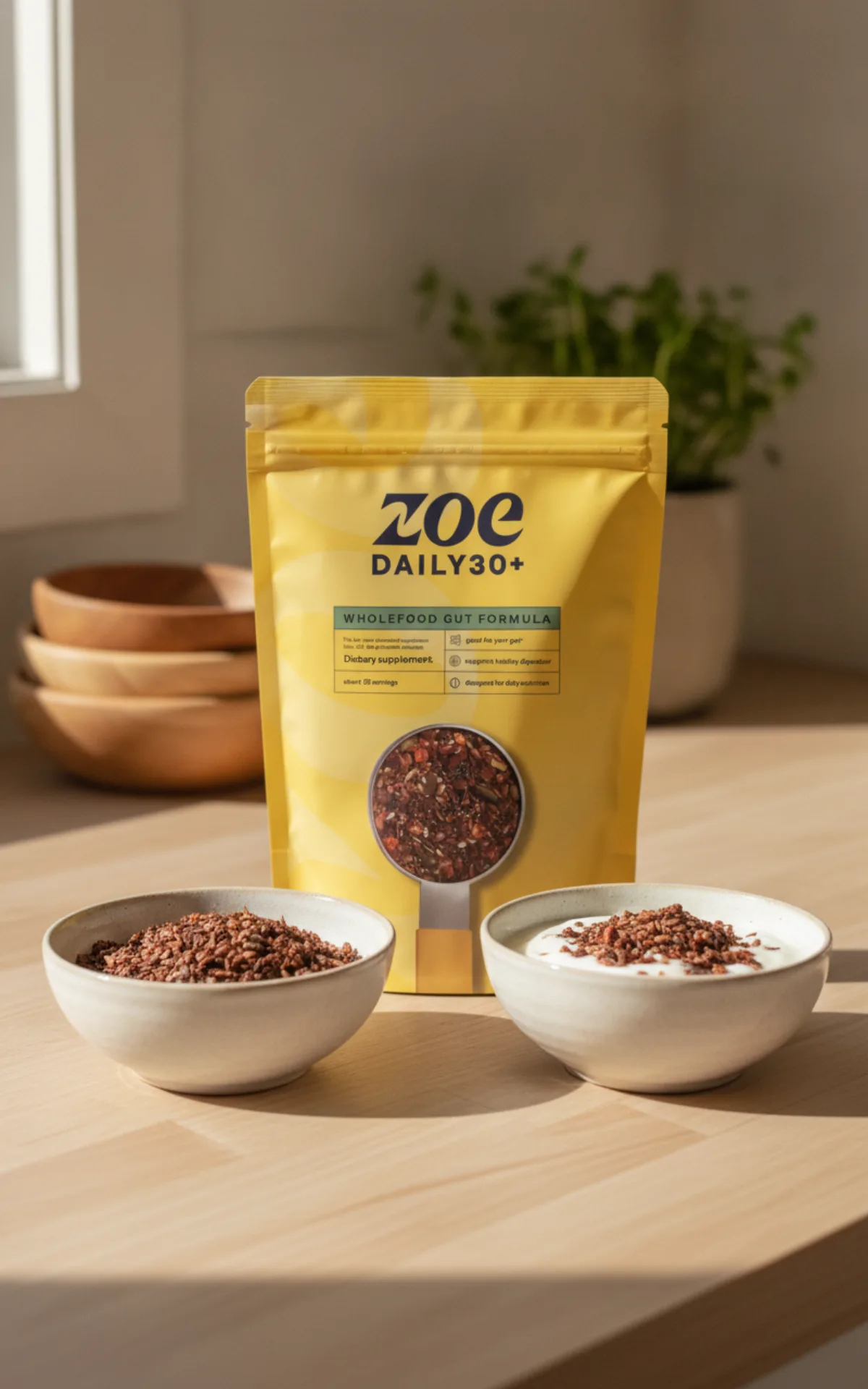
Daily30+ is a whole-food prebiotic powder built from 32 plant ingredients — and unlike most supplements, it keeps them as minimally-processed whole foods. The lineup includes:
- 🌱 Seeds & grains: flaxseed, chia, sunflower, pumpkin, hemp seeds, puffed quinoa, red lentil.
- 🥜 Nuts: almonds, hazelnuts, walnuts (note: allergen).
- 🍄 Mushrooms: shiitake, maitake, lion's mane, reishi, chaga, cordyceps, tremella (in small amounts).
- 🌿 Vegetables, herbs & extras: beetroot, carrot, onion, garlic, thyme, parsley, turmeric, cumin, rosemary, chicory inulin, baobab, nutritional yeast, seaweed.
Per 15g scoop you get ~63 calories, about 5g of fiber, 3g protein, and a spread of polyphenols — ZOE markets "353 types of fiber" and "7,000+ plant chemicals." ⚠️ Honest caveat: only the ordered ingredient list is given, not per-ingredient doses, so the headliner mushrooms (near the end of the list) are present in trace amounts. It's vegan and gluten-free, but contains nuts.
Is ZOE Daily30+ a probiotic or a prebiotic?
Clarifying this up front saves confusion: Daily30+ is a prebiotic, not a probiotic. It contains no live bacteria. Instead, it delivers diverse fiber and polyphenols that feed the good bacteria you already have.
💡 That's a meaningful difference. Probiotics add bacteria; prebiotics feed them. ZOE's own research even pitted Daily30+ against a probiotic capsule — and the plant-diversity approach is squarely aligned with the well-known "eat 30 different plants a week" advice for microbiome health. So if you're looking to add live cultures, this isn't that; if you're looking to feed your microbiome with plant diversity, this is exactly the idea.
Do you need a ZOE membership to buy Daily30+?
A very common question, because ZOE is famous for its expensive at-home test-and-app membership. The answer is reassuring: no — you can buy Daily30+ completely on its own.
💡 Daily30+ has its own standalone subscription, separate from the ZOE membership program. You do not need to buy the ZOE testing kit or pay the monthly app fee to use it. So you can try just the supplement without committing to ZOE's much pricier full program — a genuinely important point for anyone put off by ZOE's overall cost.
Does ZOE Daily30+ actually work?
This is where ZOE stands out from typical supplements: it actually ran a study. Its 6-week randomized controlled trial (349 adults) compared Daily30+ against a control and a probiotic, and reported meaningful digestive improvements, less occasional constipation and indigestion, more reported energy, and a favorable shift in gut bacteria.
A realistic ZOE Daily30+ timeline
- Week 1–2: Most people tolerate it well; some notice improved regularity and less bloating as fiber intake rises. Add water/fluids.
- Week 2–6: The RCT's window — digestion, regularity and energy improvements were reported here.
- Ongoing: Microbiome-diversity benefits build with consistent daily use alongside a varied diet.
⚠️ Honest read on the evidence: it's genuinely better-studied than almost any supplement, but the RCT has fair criticisms (the "control" wasn't fully inert), and — crucially — the effect is essentially "you ate more diverse plant fiber," which works whether it comes from Daily30+ or from your kitchen. It's effective at what it does; it's just not doing anything mysterious.
Can you make ZOE Daily30+ yourself for less?
This is the most honest question about Daily30+, and independent experts (and consumer group Which?) have pointed it out: yes, you can largely DIY it. The product is essentially a curated mix of seeds, nuts, and dried plants — ingredients you can buy in bulk.
💡 A homemade blend of ground flax, chia, mixed seeds, nuts, and a few dried mushrooms/herbs gets you most of the way to the same "diverse plant fiber + polyphenols" goal for a fraction of $65/month. What you'd be giving up is the convenience, the exact curated diversity, the specific formulation ZOE tested, and the grab-and-sprinkle format. ➡️ So the honest framing: you're paying ZOE mainly for convenience and a science-designed blend, not for something you couldn't otherwise assemble.
Is ZOE Daily30+ worth the price?
At roughly $65 for a month's supply (with a ~$220 four-month bundle), Daily30+ is expensive for what is, nutritionally, ~5g of fiber and a plant blend per day. Price is the number-one complaint.
💰 My take on the value: if you value the convenience, the curated 30+ plant diversity, and buying from a credible science brand — and you'll actually use it daily — it can be worth it as a reliable "plant diversity insurance." But if value matters most, you can hit the same goal by eating a wider variety of plants (free) or DIY-ing a seed/nut/mushroom mix (far cheaper), and get more grams of fiber from plain psyllium for a few dollars. It's a premium convenience product, priced like one.
How does ZOE Daily30+ compare to AG1, Metamucil and greens powders?
Here's how it stacks up against three products US shoppers cross-shop for "gut/greens/fiber."
| Product | Price | What it is | Strength | Weakness |
|---|---|---|---|---|
| ZOE Daily30+ | ~$65 / mo | Whole-food prebiotic, 30+ plants, ~5g fiber | Real whole-food diversity + published RCT | Pricey, only 5g fiber, contains nuts, DIY-able |
| AG1 (Athletic Greens) | ~$79–99 / mo | Greens/vitamin powder in water | All-in-one micronutrients, convenient | Very low fiber, not whole-food, proprietary, priciest |
| Metamucil (psyllium) | ~$25–30 | Single-fiber powder in water | Cheap, strong evidence for regularity & cholesterol | One fiber source, no plant/polyphenol diversity |
| Live It Up Super Greens | ~$40 / mo | Greens/superfood powder | Cheaper than AG1, broad plant range | Processed extract, not whole-food, modest fiber |
So which should you choose? For genuine whole-food fiber and plant diversity with real research, ZOE Daily30+ leads. For all-in-one vitamins (not fiber), AG1; for the cheapest proven fiber for regularity, Metamucil (psyllium); for a budget greens powder, Live It Up. ZOE wins on whole-food diversity and evidence, not on price or fiber grams.
Are there side effects to ZOE Daily30+?
As a food-based fiber product, it's generally very well tolerated. The main effect is the usual: a bit of extra gas or bloating as your fiber intake increases, which settles as your gut adjusts — start with a smaller amount and drink fluids.
⚠️ Keep in mind before taking ZOE Daily30+:
- It contains nuts (almonds, hazelnuts, walnuts) — not suitable for nut allergies.
- If you have a diagnosed GI condition (like IBS or a FODMAP sensitivity), note it contains onion, garlic, inulin and chicory, which can trigger symptoms — introduce carefully.
- Increase fiber gradually and keep hydrated; take it apart from medications, as fiber can affect absorption.
Supplements and foods like this aren't a treatment for any condition. It's a plant-diversity booster to complement a varied diet, not a substitute for medical care.
What do real customers say about ZOE Daily30+?
Feedback is generally positive, with consistent themes:
👍 The positives: it's easy to sprinkle into daily meals, many report improved regularity and reduced bloating within a couple of weeks, some feel fuller and snack less, and ZOE's customer support is well-rated.
👎 The negatives: the price dominates complaints (and the "you could DIY it" critique); the taste/texture is neutral-to-gritty and can get monotonous; the nut allergen excludes some; and skeptics feel the benefits are really just "eat more plants" repackaged at a premium.
So, should you buy ZOE Daily30+?
Is ZOE Daily30+ worth it? My verdict is yes, if you value convenience and science — 7.5/10.
To my mind, this is one of the few supplements whose concept is genuinely evidence-aligned: diverse whole-food fiber and polyphenols to feed your microbiome, from a credible science brand with a published trial, in an easy sprinkle-on format. If that fits how you eat, it's a legitimately good product.
What keeps it out of the higher range is honest: it delivers only ~5g fiber, per-ingredient doses aren't disclosed, it contains nuts, and at ~$65/month it's pricey for something you can approximate at home — it's food, not medicine.
- 👍 Buy ZOE Daily30+ if you want a convenient, science-designed whole-food plant-diversity booster and you'll use it daily (no membership needed).
- 👎 Skip it if you're budget-focused (eat varied plants or DIY a seed/nut mix), want maximum fiber grams (psyllium), or have a nut allergy.
➡️ Bottom line: a rare supplement that's actually built on good science — worth it for the convenience and diversity if the price works for you, but it's essentially "more plants, sprinkled," which you can also get from your kitchen.
Standalone subscription — no ZOE membership or test kit required.
ZOE Daily30+ FAQ
Is ZOE Daily30+ a probiotic?
No. It's a whole-food prebiotic with no live bacteria — a blend of 30+ plants providing diverse fiber and polyphenols that feed your existing gut bacteria. If you want live cultures, that's a probiotic, which is a different product.
Do you need a ZOE membership to buy Daily30+?
No. Daily30+ has its own standalone subscription, separate from ZOE's test-and-app membership. You can buy just the supplement without the kit or monthly program fee.
What's in ZOE Daily30+?
32 whole-food plant ingredients — seeds (flax, chia, sunflower, pumpkin, hemp), nuts (almond, hazelnut, walnut), mushrooms (shiitake, lion's mane, reishi and more), vegetables and herbs, plus chicory inulin and baobab. Each 15g scoop gives about 5g of diverse fiber and polyphenols. It's vegan and gluten-free but contains nuts.
Does ZOE Daily30+ actually work?
ZOE's own 6-week RCT reported improved digestion, less constipation, more energy and a favorable microbiome shift. It's better-studied than most supplements, though the effect is essentially "more diverse plant fiber" — genuinely useful, but not mysterious.
Can you make ZOE Daily30+ at home for cheaper?
Largely, yes — a homemade mix of ground flax, chia, mixed seeds, nuts and some dried mushrooms/herbs approximates the same plant-diversity goal for far less. You'd give up the convenience and the exact tested blend. You're mainly paying ZOE for convenience and formulation.
How much does ZOE Daily30+ cost?
About $65 for a one-month supply, with a roughly $220 four-month bundle. It's premium-priced for ~5g of fiber a day, which is the most common criticism.
Are there side effects to ZOE Daily30+?
Mostly just extra gas or bloating as fiber intake rises, which settles with time and fluids. It contains nuts (an allergen), and the onion/garlic/inulin content can trigger symptoms in people with IBS or FODMAP sensitivity, so introduce it carefully.
Keep reading before you buy ZOE Daily30+
A little context helps you judge a premium gut product:
- How to read a supplement and medication label — so ingredient lists and fiber grams are clear.
- How to buy medications and supplements online safely — including managing subscriptions.
Disclaimer: This ZOE Daily30+ review is independent editorial information, not medical advice. Dietary supplements and food products are not intended to diagnose, treat, cure or prevent any disease, and individual results vary. Talk to a licensed healthcare professional before starting any new supplement, especially if you have a nut allergy, IBS/FODMAP sensitivity, or take medication. This page may contain affiliate links; we may earn a commission at no extra cost to you, which never changes our honest assessment. Pricing was accurate at the time of writing (July 2026) and may change — verify on the official site.